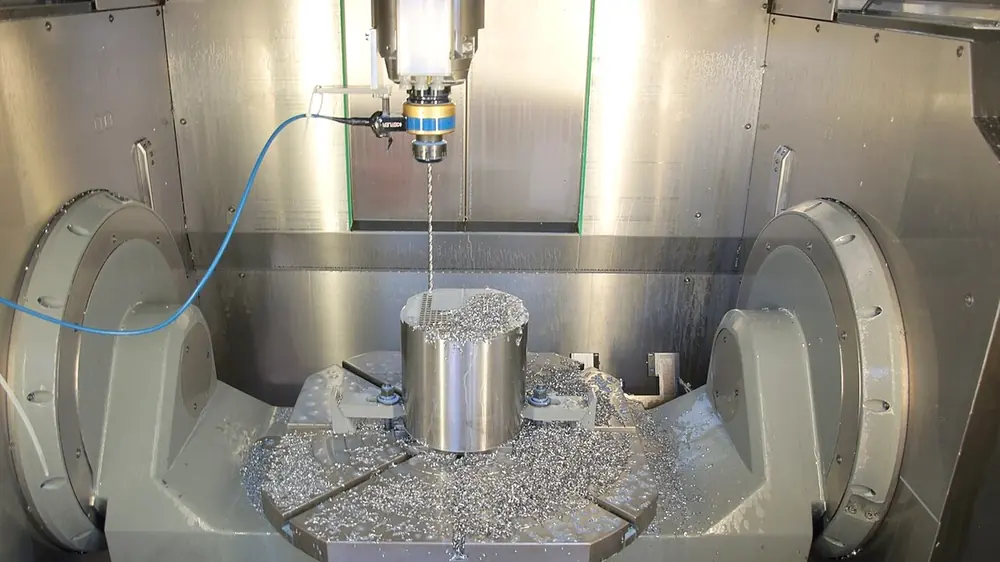
### 1. The Core Machining Center Trade-off
The **DRC VMC850 and VMC855** represent the workhorse sweet spot for precision metalworking: 800mm to 850mm X-axis stroke, accommodating standard automotive brackets, pump bodies, die sets, and aerospace fixtures.
However, when finalizing equipment specifications, engineering managers face two decisive architectural questions: 1. **BT40 or BT50 spindle taper?** 2. **Roller linear guideways or solid box ways?**
---
### 2. Spindle Taper Comparison: Speed vs Heavy Shear Strength
#### BT40 Spindle Architecture - **Optimal RPM Range**: 8,000 to 15,000 RPM (Direct Drive or Ceramic Bearing Spindles). - **Tool Shank Diameter**: ø44.45 mm gage line. - **Application Realm**: Aluminum housings, electronics components, small diameter end-milling (ø1mm to ø20mm), high-speed finish 3D surfacing of mold cavities. - **Advantages**: Lower centrifugal expansion at high RPMs, faster tool change cycles (1.5 - 1.8s), lower toolholder capital investment.
#### BT50 Spindle Architecture - **Optimal RPM Range**: 4,500 to 8,000 RPM (Belt or Dual-Range Gearbox Drive). - **Tool Shank Diameter**: ø69.85 mm gage line (more than **2.5× the cross-sectional contact area** of BT40). - **Application Realm**: Large face-milling cutters (ø100mm to ø160mm), heavy roughing of tool steels (H13, P20, D2), titanium and high-nickel alloys. - **Advantages**: Massive bending moment resistance, high torque at low speeds (up to 350+ Nm), zero tool pull-out under extreme axial loading.
---
### 3. Axis Guideway Technology: Linear Roller vs Hardened Box Way
In past decades, box ways were mandatory for heavy steel roughing. However, contemporary **45mm heavy roller linear guideways** (as implemented on the **DRC VMC855**) have fundamentally transformed this calculation:
- **Roller Contact Mechanics**: Cylindrical roller guides provide line-contact instead of ball-contact, yielding 90% of a box way's dampening rigidity while retaining near-zero friction. - **Speed**: Rapid traverse rates reach **36 m/min**, compared to just 16-20 m/min on conventional box ways. - **Zero Stick-Slip**: Micro-stepping positioning accuracy down to ±0.003 mm is effortlessly maintained.
---
### 4. Spindle & Guide Selection Matrix
| Machine Model | Standard Guideway | Standard Spindle | Optimal Material / Workpiece | | :--- | :--- | :--- | :--- | | **DRC VMC650** | 35mm Roller Linear | BT40 Direct 12,000 RPM | Aluminum, Copper, Medical Implants, Small Molds | | **DRC VMC850** | 45mm Roller Linear | BT40 Belt/Direct 10,000 RPM | Automotive brackets, Valves, General Steel & Iron | | **DRC VMC855** | 45mm Heavy Roller | BT50 High-Torque 8,000 RPM | Heavy Tool Steels, Forgings, Deep Mold Cavities |
*Need consultation on spindle thermal drift control or CTS (Coolant Through Spindle) options? Reach out to xiuc32860@gmail.com.*
The **DRC VMC850 and VMC855** represent the workhorse sweet spot for precision metalworking: 800mm to 850mm X-axis stroke, accommodating standard automotive brackets, pump bodies, die sets, and aerospace fixtures.
However, when finalizing equipment specifications, engineering managers face two decisive architectural questions: 1. **BT40 or BT50 spindle taper?** 2. **Roller linear guideways or solid box ways?**
---
### 2. Spindle Taper Comparison: Speed vs Heavy Shear Strength
#### BT40 Spindle Architecture - **Optimal RPM Range**: 8,000 to 15,000 RPM (Direct Drive or Ceramic Bearing Spindles). - **Tool Shank Diameter**: ø44.45 mm gage line. - **Application Realm**: Aluminum housings, electronics components, small diameter end-milling (ø1mm to ø20mm), high-speed finish 3D surfacing of mold cavities. - **Advantages**: Lower centrifugal expansion at high RPMs, faster tool change cycles (1.5 - 1.8s), lower toolholder capital investment.
#### BT50 Spindle Architecture - **Optimal RPM Range**: 4,500 to 8,000 RPM (Belt or Dual-Range Gearbox Drive). - **Tool Shank Diameter**: ø69.85 mm gage line (more than **2.5× the cross-sectional contact area** of BT40). - **Application Realm**: Large face-milling cutters (ø100mm to ø160mm), heavy roughing of tool steels (H13, P20, D2), titanium and high-nickel alloys. - **Advantages**: Massive bending moment resistance, high torque at low speeds (up to 350+ Nm), zero tool pull-out under extreme axial loading.
---
### 3. Axis Guideway Technology: Linear Roller vs Hardened Box Way
In past decades, box ways were mandatory for heavy steel roughing. However, contemporary **45mm heavy roller linear guideways** (as implemented on the **DRC VMC855**) have fundamentally transformed this calculation:
- **Roller Contact Mechanics**: Cylindrical roller guides provide line-contact instead of ball-contact, yielding 90% of a box way's dampening rigidity while retaining near-zero friction. - **Speed**: Rapid traverse rates reach **36 m/min**, compared to just 16-20 m/min on conventional box ways. - **Zero Stick-Slip**: Micro-stepping positioning accuracy down to ±0.003 mm is effortlessly maintained.
---
### 4. Spindle & Guide Selection Matrix
| Machine Model | Standard Guideway | Standard Spindle | Optimal Material / Workpiece | | :--- | :--- | :--- | :--- | | **DRC VMC650** | 35mm Roller Linear | BT40 Direct 12,000 RPM | Aluminum, Copper, Medical Implants, Small Molds | | **DRC VMC850** | 45mm Roller Linear | BT40 Belt/Direct 10,000 RPM | Automotive brackets, Valves, General Steel & Iron | | **DRC VMC855** | 45mm Heavy Roller | BT50 High-Torque 8,000 RPM | Heavy Tool Steels, Forgings, Deep Mold Cavities |
*Need consultation on spindle thermal drift control or CTS (Coolant Through Spindle) options? Reach out to xiuc32860@gmail.com.*
Application Engineering Advisory
Have specific machining tolerances or difficult alloy workpieces?
Send your engineering drawings or material specifications directly to our senior CNC application engineering desk. We provide comprehensive cycle time calculations, tool path suggestions, and recommended machine configurations within 24 hours.
Related Engineering Articles
Engineering Guide
Slant Bed vs Flat Bed CNC Lathe: The Complete Engineering & Buyer Guide
Understand how structural geometry, thermal expansion vectors, chip evacuation dynamics, and tooling ergonomics dictate whether your plant needs a 45° slant bed (TCK series) or a universal flat bed (CK series).
Factory Economics
Total Cost of Ownership (TCO) in CNC Machinery: Calculating 10-Year ROI and Precision Retention
Why purchasing on initial price tag alone often leads to 300% higher lifecycle costs. How casting aging, Renishaw laser compensation, and thermal stabilization drive true machining profitability.